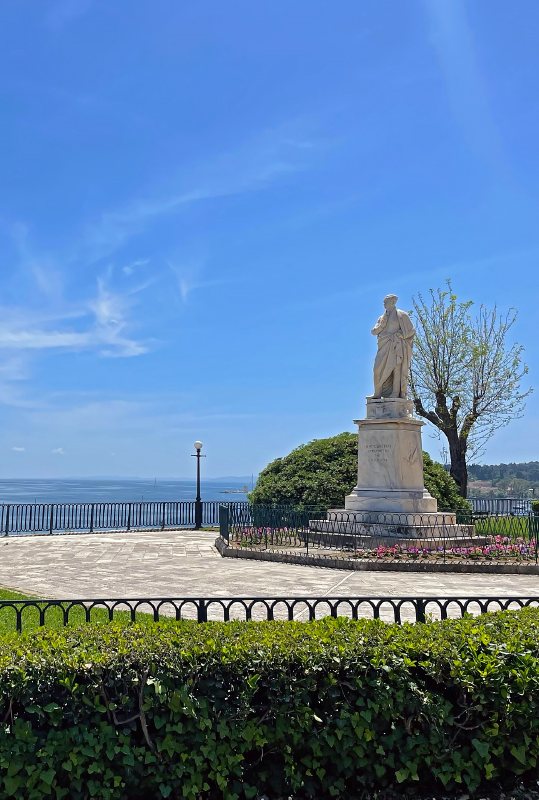
You now get to admire the statue of Ioannis Kapodistrias, one of the most important figures of modern Greece (and indeed of early 19th-century European history) with a backdrop of the Old Fortress on one side and Garitsa Bay right in front of you.
10. Statue of Ioannis Kapodistrias
Stories

One of Greece’s greatest statesmen
The Kapodistrias family
Count Ioannis Kapodistrias was born in 1776 in Venetian-occupied Corfu. He grew up with eight brothers and sisters in a strictly patriarchal and religious family. It was one of the oldest families on the island and was prominent in the political, economic and social affairs of the country. It is said that the Kapodistrias family arrived in Corfu at the end of the 14th century from the town of Capo d'Istria, in present-day Slovenia. Although their family name was Vittori, they soon went by the surname that identified their origins.
First steps in education
Like other noblemen of the time, Kapodistrias studied medicine, philosophy and law in Padua, Italy, from 1794-1797. He returned to Corfu where he practised medicine and was known as the doctor of the poor. Today, he is one of the 40 most distinguished graduates of the university, alongside figures like Galileo and Copernicus.
First steps in politics
Kapodistrias’ return coincided with the end of Venetian rule and the arrival of the French Republicans, who sought radical social change. In 1799, after a four-month siege of Corfu by Russian-Turkish forces, the French Republicans withdrew. And in 1800, the Ionian State was formed as the first modern Greek state, albeit mainly under Russian control. He became involved in politics until the Ionian State was abolished in 1807 with the arrival of the Imperial French.
Kapodistrias in Russia and Switzerland
In 1808, the Russian Tsar Alexander I invited Ioannis Kapodistrias to serve in the Russian Foreign Ministry and, five years later, he was appointed head of the first Russian diplomatic mission to Switzerland, where his role in the formation of the neutral Swiss Confederation and the drafting of the new Swiss constitution was instrumental in Switzerland’s independence from Napoleon’s France. In recognition of his accomplishments, he was made an honourary citizen of Geneva and Vaud (including Lausanne) and wreaths are still laid each year at his home in the old town of Geneva. While in Switzerland, he was active in spreading philhellenism within Europe and financially supporting Greece’s struggle for liberation.
Disagreement with Russia
In 1814, Kapodistrias became a close associate of Alexander I at the Congress of Vienna, which had been convened to determine the political and constitutional order of Europe after the Napoleonic Wars. And in 1816, the Tsar appointed him second minister of foreign affairs. His relations with Russia were severed in 1822 due to his disagreement with Alexander I over Russia’s position on the liberation of Greece from the Turks.
The first Governor of Greece
In 1827, the Greek National Assembly unanimously selected Kapodistrias to be the first head of state of newly liberated Greece. As Greece’s first governor, he undertook innovative reforms and changes that transformed Greece. He was determined to reshape the country according to a specific plan that required a concentration of power. And from the outset, he secured the cooperation of representatives from all the leadership groups and reestablished military unity. In this way, he established internal peace and ensured that the government apparatus functioned with a degree of competence and organization. Among other things, he established orphanages for the children of the independence struggle, hospitals and schools, as well as libraries and the country’s first archaeological museum.
The end
In his attempt to create a European state, Kapodistrias made political enemies as he fought corruption and opposition forces. His disagreements with the powerful merchant families of Hydra, Spetses and Psara and of Mani in the southern Peloponnese were intense. And it was his clash with the Mavromihalis family in Mani that cost Kapodistrias his life. On Sunday 27 September 1831, he was assassinated in front of the Church of St Spyridon in Nafplion by the son and brother of Petrobey Mavromichalis, a revolutionary hero and leader of the Maniot people. On hearing of Kapodistrias' death, Goethe said: "From today, I cease to be a Philhellene". His was buried in Corfu in the Monastery of Platytera, next to the tomb of his father. An unprecedented chapter in modern Greek history had closed.
Tip
You can see the building in which Kapodistrias was born (Kapodistrias Mansion on Kapodistrias Street (you’ll be close when you reach Stop 22) and visit his burial site in the Platytera Monastery on the outskirts of the Old Town. The family's farmhouse (about 6.5km outside town) also houses the Kapodistrias Museum, where you can learn more about the life and family of Greece's first governor.
Directions
With the sea on your right, cross the roads in front of the Ionian Academy and enter the large, tree-filled square, which is your next stop.
Discover Greece

Powered by Clio Muse Tours
Powered by Clio Muse Tours