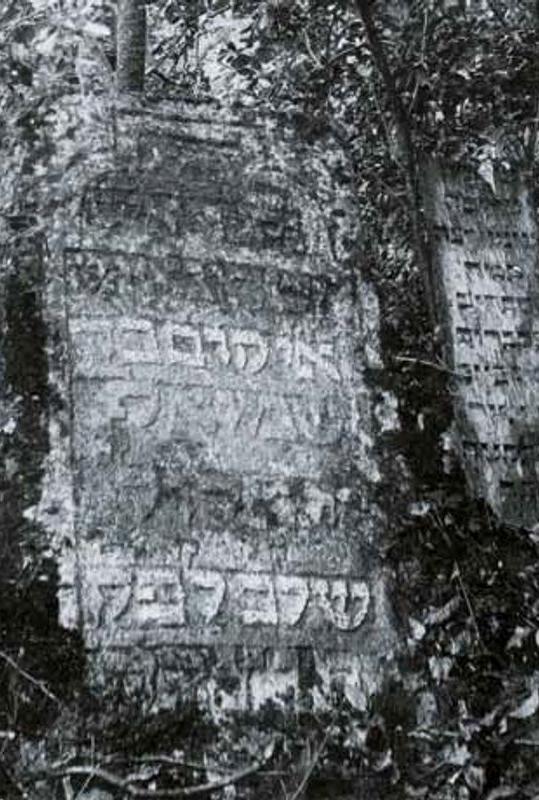
New Cemetery (3 Mają Street)- It was probably established at the turn of the 20th century. Among the fields, on an area of 0.4 hectares, at a distance of approx. 50 m from the road leading towards the village of Tuczapy.During World War II it was devastated by the Germans, after the war the area of the cemetery was used for agricultural fields. In 1988. On the initiative of David Laks, Abraham Borg and the local community, a section of the cemetery was fenced off, a lapidarium was arranged there from a dozen or so recovered tombstones, and four symbolic steles dedicated to the Jews of Tyszowce who were murdered by the Germans during World War II were set up. A metal fence with a gate was also built and a Star of David was placed on it.The cemetery contains tombstones of Jews murdered during the Nazi occupation. Fragments of matzevot found in the Tyszowce area are brought to the cemetery.Holocaust - October 8, 1939. With the retreating Red Army, between 1,000 and 2,000 Jews fled eastward from Tyszowce. In the spring of 1940. A ten-member Judenrat was established in the settlement, with merchant Zelig Cukier as its chairman.A branch of the Jewish Order Service was established at the Judenrat.The Germans deported about 150 Tyszowiec Jews to a labor camp in Zamość. In turn, numerous groups of Jews were resettled in Tyszowce, including. from Warsaw, Otwock and Lublin.A few hundred displaced persons were employed in the Tyszowce-based operation from the fall of 1940. labor camp. Prisoners worked on regulating the Huczwa River and building roads.The camp was liquidated in the fall of 1941.The first mass execution of Jews took place on the night of April 16-17, 1942. The Nazis executed several hundred people, and buried their bodies in a mass grave.On May 25, 1942. ca. 800 Jews were deported from Tyszowce to Zamość, and from there, two days later, to the Sobibor extermination camp.Resisting, among others. Zelig Cukier and other members of the Judenrat, died on the spot. Before deportation from Tyszowce, a small group of young men escaped to the forest.Some of them formed partisan units there, organizing armed actions against the Germans and Polish collaborators. About 600-1000 Jews were confined by the Germans in a ghetto created between the old riverbed of the Huczwa River and Zamłyn.Among them were also several Jewish families deported from the Czech Republic.A new Judenrat was established.In September 1942. The Germans carried out another execution, in which they shot 49 Jews.The liquidation of the ghetto took place in November of that year.The Germans shot 22 people on the spot, the remaining about 70 were transported in wagons to Belzec.
4. Tyszowce - Nowy cmentarz żydowski (ul. 3 Maja)
Stories

Tyszowce - New Jewish cemetery (3 Maja St.)
Jewish History Tours

Powered by Clio Muse Tours
Powered by Clio Muse Tours