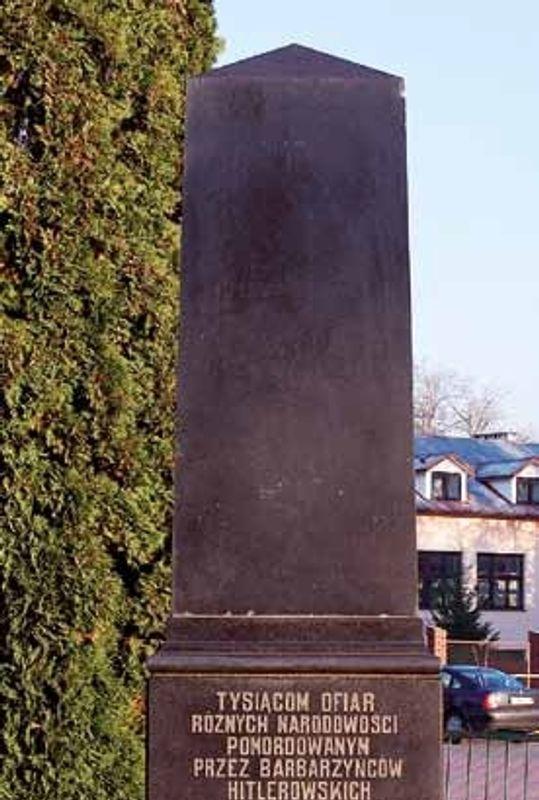
Holocaust - In early October 1939. With the retreating Red Army behind the Bug River, a small group of Jews, mostly men, escaped from Trawniki. March 23, 1942. Jews from Biskupice, Piaski and other nearby towns were resettled to Trawniki - a total of about 2,300 people.Along with about. The 200 Jews from Trawniki were driven to the train station, from where they were deported to the Belzec death camp. From June 1942. operating on the site of the sugar factory was transformed into a labor camp for Jews, sent here from various cities in Poland, Germany, the Netherlands, the Czech Republic and Slovakia. They worked in artisan workshops (shoemakers, tailors, hosiery makers, furriers), producing on orders from the Wehrmacht, as well as sorting Jewish property brought in by trains from the death camps in Belzec and Sobibor. From the end of 1942. Fur, brush and bristle workshops operated in the camp, transferred with the Jewish crew from Miedzyrzec. Initially, the prisoners lived in the halls and warehouses of the former sugar factory, but later 45 wooden barracks were built for them. From February 1943. The tailor and furrier workshops of the Fritz Schulz company, along with the 6296 Jewish workers employed there, were moved to Trawniki from the Warsaw Ghetto. From spring to November 1943. In nearby Dorohucza there were peat factories, a branch of the Trawniki camp. They served as a prison camp for 300-500 prisoners from Trawniki, employed in peat mining and drying. In April and May 1943. Jews captured during the Warsaw Ghetto Uprising and a large group of Jews from the Netherlands were brought to the Trawniki camp. In August of that year, Jews from Bialystok were brought to Trawniki, while in September they were brought from Minsk and Smolensk. In terms of the number of prisoners, the Trawniki camp was the third-largest camp in the Lublin District in the fall of 1943, after Majdanek and Poniatowa. It contained approx. 8500-10,000 Jews.About 4,000 prisoners died in the camp due to disease and starvation.It was liquidated on November 3, 1943. As part of the "Erntefest" (Harvest Festival) campaign.The Germans executed the prisoners in the execution trenches. At that time they murdered between 6,000 and 10,000 Jews.After the liquidation of the camp, the barracks were dismantled.In December 1943. The bodies were exhumed and burned on hearth piles near the trenches. From September 1941. Next to the labor camp for Jews there was a training center for about 1,000 soldiers of the SS auxiliary formations (SS-Ausbildungslager). Soviet prisoners of war (many of them from Ukraine) and Volksdeutsche from Eastern Europe, declaring their willingness to cooperate with the SS, were directed to it. Following the training were, among others. guards in extermination and concentration camps (including Belzec, Sobibor, Majdanek), liquidated ghettos (including those in Warsaw and Lublin) and fought with partisan units. The training camp operated until July 1944.In 1942-1943 in Trawniki there was also a labor camp of the construction service.About 100 people worked there in the expansion of the railroad line. Some of the buildings of the former camp still exist today.They are located on the territory belonging to the Trawena Knitting Industry Plant (1 Przemysłowa Street) and are not open to the public. In the 1960s., at the site of the November 3, 1943 execution., unveiled a monument with the inscription: "To the thousands of victims of different nationalities, murdered by the Nazi barbarians in the Trawniki camp in 1939-1945. Society of Lublin County." On September 30, 2001. Thanks to the efforts of David Efrati - a former prisoner of the Trawniki camp, a second plaque was placed on the monument with the inscription: "On November 3, 1943, the Germans murdered about 10,000 Jews from various European countries."In 2013, a mural was unveiled to evoke the memory of a Jewish labor camp operating in Trawniki during the German occupation.
2. Trawniki - Pomnik ofiar obozu w Trawnikach
Stories

Trawniki - Monument to the victims of the Trawniki camp
Jewish History Tours

Powered by Clio Muse Tours
Powered by Clio Muse Tours