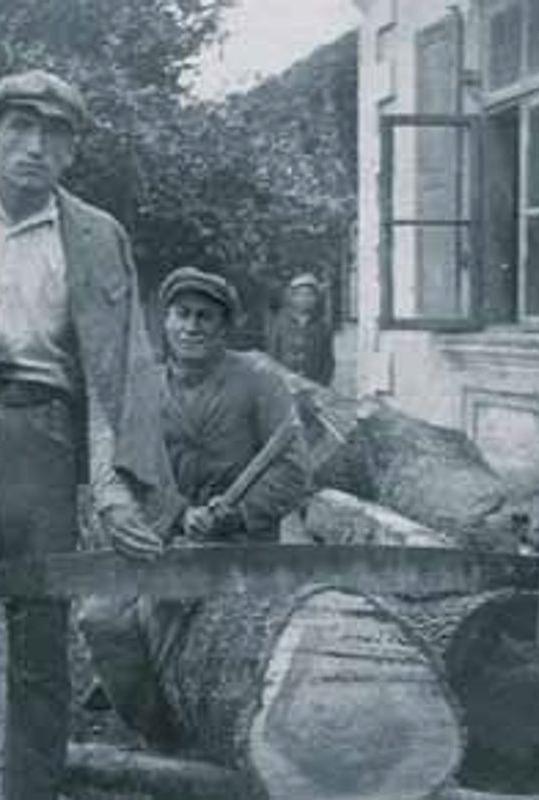
The village of Skryhiczyn in Horodlo district is mentioned in historical sources as early as 1472.In the 19th century. The estate was owned by the Zbyszewski family. In 1864 or 1867. due to the indebtedness of the owner, Zygmunt Zbyszewski, they were auctioned off and purchased by the German settler Wilhelm Bergeman, who erected a dam here, built a bridge, mill and sawmill, established fish ponds, and brought in skilled laborers from Germany to work in the enterprises he established. In 1871 Skryhiczyn was bought by Mordko Kalman Rottenberg - a Jewish merchant from nearby Dubienka. In the late 19th and early 20th centuries. The village had an ethnically and religiously diverse population. In the early 1920s. The majority of residents were Jews, living alongside Orthodox Christians and Catholics.Jews in Skryhiczyn - Until 1918. - A large group of Jews settled in Skryhiczyn in the last quarter of the 19th century. Mordek Kalman Rottenberg's son and heir, Shmuel, brought many Jewish artisans, foresters and rafters to the estate, for whom he built housing and farm buildings. He also erected a mansion on the hill at the entrance to the village, where he and his family lived.Many of the Jews in Skryhiczyn were Hasidim - followers of the dynasty of tzaddikim from Mount Calvary. In the early 20th century. A Reform cheder was established here, where children were taught in Russian and Hebrew. Even before World War I, there were various political parties in Skryhiczyn, among which those with a Zionist profile were very popular.Help for the needy was provided by Jewish social organizations. After the outbreak of World War I, in August 1914., the Rottenbergs, along with the entire population of the village, were evacuated to Russia.Interwar period - After Poland regained its independence, the Rottenbergs attempted to raise Skryhiczyn, which had been plundered and nearly burned to the ground, from decline. Due to the deepening economic crisis, the reconstruction of the estate, divided among Mordek Rottenberg's 26 heirs, proceeded very slowly. In the late 1930s. Anti-Semitic sentiment and economic conflicts between the Orthodox, Catholic and Jewish populations of the village intensified in Skryhiczyn. Members of the Rottenberg family moved to other cities or emigrated to Palestine.Holocaust - After the outbreak of war, the Rottenberg family scattered across Poland and returned to the family estate. From there, many of them, along with other Jewish residents of Skryhiczyn, fled to the Soviet Union, where most survived the war. After the Germans occupied the village in September 1939. There was a pogrom in which six members of one Jewish family were killed.Probably in November 1941. The Germans resettled some Jews from Skryhiczyn to Hrubieszow.There the Jews were forcibly employed in a labor camp. In June 1942. - along with Jews from the Hrubieszow ghetto - the Germans deported them to the Sobibor death camp. Some of the Jews from Skryhiczyn may also have been taken to the ghetto in Dubienka, then to Dorohusk, and from there they were most likely deported to the Sobibor death camp. September 10, 1942. A public execution took place in Skryhiczyn - in retaliation for the wounding of a German gendarme by Polish partisans. The Germans executed four Jews, while 42 men - mostly Poles and Ukrainians - were taken to the Majdanek camp. The Jews who remained in the village were herded to the train station, then deported to the Sobibor death camp. Several Jews escaped from Skryhiczyn even before the deportation - some of them hid in the forests, some joined partisan units. In October 1948. The exhumation of the victims of the 1942 executions took place.Their remains were buried in the Jewish cemetery on ul. Okopowa in Warsaw.
1. Skryhiczyn - Centrum miejscowości
Stories

Skryhiczyn - center of the village
Jewish History Tours

Powered by Clio Muse Tours
Powered by Clio Muse Tours