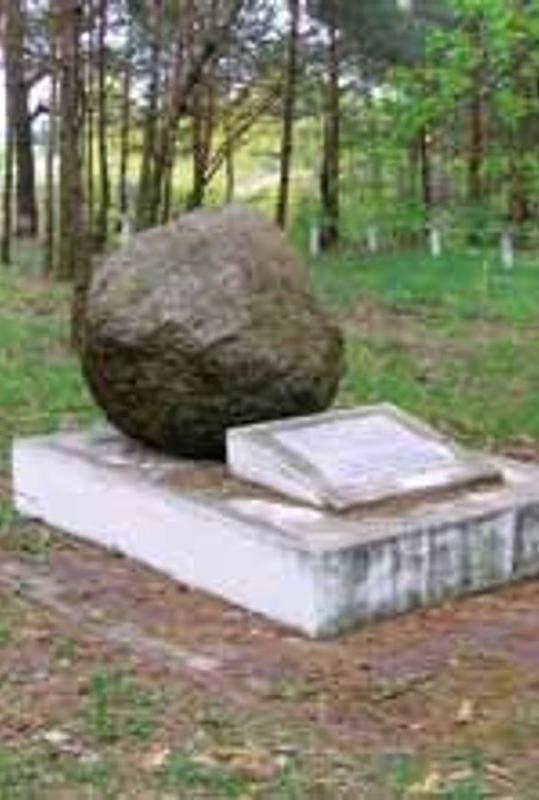
Cemetery (Chutecka Street) - was probably established in the 18th century. Outside the city limits, northwest of the market, on the right side of the road leading from Chelm to the village of Chutcze. The last burial, took place there in 1943.During World War II it was devastated.Its original layout is not legible. Five fragments of tombstones dating back to the 20th century have been preserved on the tree-lined 0.2-acre site., there are inscriptions in Hebrew on two gravestones. In 2000-2001, on the initiative of the descendants of Sawin's former Jewish residents - Filip Goldstein from Canada and Mordechai Holcblat from Israel - and with the cooperation of local authorities, the cemetery was cleaned up and fenced with a wooden fence. A commemorative boulder with a plaque and inscription was also placed on it: "To the memory of Savin's Jews buried in this holy place and murdered by the Nazis in 1939-1944."Holocaust - In September 1939., after Sawin was occupied, the Germans formed a Judenrat, with Szapsa Rojter as its chairman. In 1940 or 1941., between Brzeska, Kościelna, market and pl. A ghetto has been established in Church Street. Between 1940 and 1942. Jewish resettlers from Krakow, Gorzow, Wroclaw and Warsaw came to Sawin. In May 1942. the ghetto was closed, soon most of the Jews in it were deported by the Germans to the Sobibor extermination camp.During the deportation, several Jews escaped from the marching column. About a dozen other Jews from Sawin, who were given shelter by Poles, also survived.During the occupation, the Germans destroyed the synagogue and the beit ha- midrash. Between 1940 and 1943 there was a labor camp in Sawin, through which approx. 3,000 people-Jews from Sawin and Ruda, as well as displaced persons from other ghettos in the General Government and from the Czech Republic, Slovakia, Austria, Germany-were forcibly employed to regulate the Uherka River. During the liquidation of the camp (April 1943), some prisoners were deported to Sobibor, while others were sent to the labor camp in Krychow.A labor camp for Jews also operated in the village of Sajczyce. Jews from Poland and later also from the Czech Republic worked there (a total of about 600 people), at the reclamation of the Garka River, in the tailor and shoemaker workshops. The camp was liquidated in the winter of 1942/1943., and all Jews were deported by the Germans to the Sobibor extermination camp.Another labor camp for Jews was established in 1941. In nearby Tomaszowka. The Jews who stayed there worked at regulating the Krzemianka River.Their further fate is unknown.
5. Sawin - Cmentarz żydowski (ul. Chutecka)
Stories

Sawin - Jewish cemetery (Chutecka Street).
Jewish History Tours

Powered by Clio Muse Tours
Powered by Clio Muse Tours