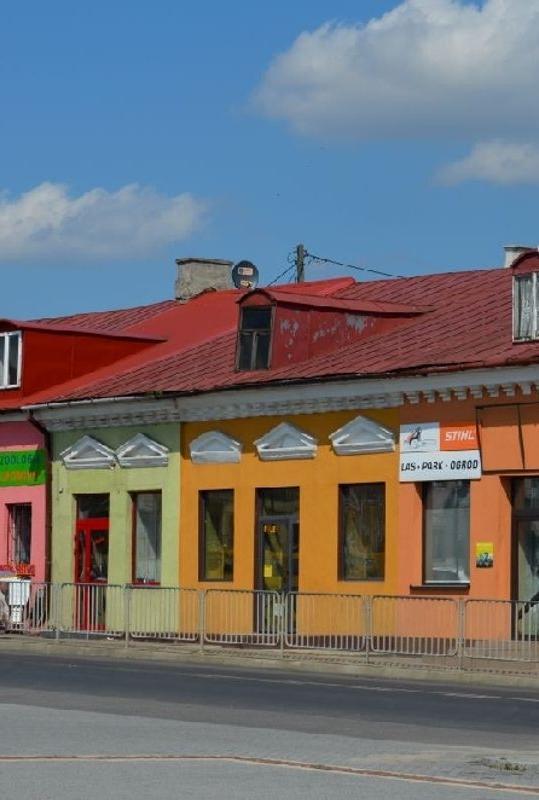
In 1167. By the grant of the Mazovian Duke Bolesław Kędzierzawy, Kock became the property of the Plock bishops. In the 13th century. Thanks to its favorable location on the route leading to Lublin and Lubomla, it developed as a trade center. In 1417. On the initiative of the Bishop of Plock, Jakub of Korzków, by virtue of a privilege from King Wladyslaw Jagiello, it was granted Magdeburg city rights, along with the privilege of weekly markets and two fairs per year. Despite frequent Tartar invasions in the 15th century. The city was growing economically and demographically. In 1512. It came into the possession of King Sigismund I, who in 1518 or 1522. He bestowed it on Mikołaj Firlej. Mikolaj's brother, Jan Firlej, built a magnificent mansion in Kock, while he turned the local church into a Calvinist congregation, at which his son Jedrzej founded a school, which remained in operation until 1648. Until the mid-17th century, Kock was one of the most important Calvinist centers in the area - 11 synods were held there between 1601 and 1644. Thanks to the Firlej family, the city also developed as a trade and craft center.In the mid-17th century. Khmelnytsky's Cossacks destroyed the town, burned down the castle, the Calvinist school with its rich book collection and murdered most of the local Jews.Further destruction was brought by the Swedish wars - Kock was ransacked again. In the 18th century. Thanks to the privileges granted by successive owners, the city slowly rose from decline.Its development was hampered by, among other things. Frequent fires and a plague epidemic (1708-1715). Kock, ruined after the November and January uprisings, in 1870. It lost its municipal rights. At the end of the 19th century. The settlement included a parish church, an elementary school, a postal station, a community office, a pharmacy, two oil mills, a soap and vinegar factory and two mills. The settlement was inhabited in half by Christians engaged mainly in agriculture and Jews engaged in trade and crafts. The city was rebuilding, but difficult economic conditions, epidemics of typhoid fever, measles and scarlet fever (in 1910-1919) caused Kock to lose almost a third of its population. Further destruction and a large decline in the number of residents was brought by World War I.After regaining independence, a devastated, neglected and depopulated Kock slowly recovered from its decline. In 1919. regained city rights, and in the mid-1920s, among other things. Thanks to bus connections to Lublin, Lukow and Deblin, there has been some economic revival in the city. Still, Kock was a small agricultural and craft center.In September 1927. A significant part of the city (Wesoła, Jateczna, Górecka, Komendancka, Radzyńska, Browarna, Polna, Pocztowa, Zaszklona and Warszawska streets) burned down. It was rebuilt fairly quickly, with stone and brick buildings replacing the old wooden houses. Jews in Kock - Until 1918. - It is likely that the first Jews appeared in Kock as early as the first quarter of the 16th century. or early 17th century. The community grew rapidly economically and demographically.Probably before the middle of the 17th century. An independent community was established here.In 1648, Khmelnytsky's Cossacks slaughtered the local Jews. The Kock municipality was reborn in the early 18th century. In a document from 1700. The owner of the estate, Maria de la Grange Wielopolska, obliged the Jews of Kock to work on repairing dikes and bridges, to serve as night guards and to help with fires and natural disasters. In a 1786 publication. A six-volume work entitled. The laws common to the estates of my governors heiress Duchess Anna Jablonowska regulated the rights and obligations of the Jews of Kock. In 1773. issued a separate Uniwersal for the Jews of the Kock estate, including. The ban on their purchase of honey, wax and linen and adulteration of alcohol. The Jews had the right to have their own judiciary, but the verdicts of the kahal court had to be approved by the duchess, and cases between Jews and Poles were settled by the city court, in which the Jews had a representative. The court's approval was also required for municipal elections, as well as issues related to the sale of real estate by Jews. To avoid an exodus of Jews to other cities, the Duchess ordered that every Jew leaving Kock pay one-sixth of the value of his property into the public coffers. The money could be recovered upon return to the city, as long as it occurred before three years.In the first quarter of the 19th century.Jews dominated local trade and crafts. In the 19th century. among others. The increase in Kock's importance as a Hasidic center led to rapid demographic growth in the community. .
1. Kock - Centrum miejscowości
Stories

Kock - village center
Jewish History Tours

Powered by Clio Muse Tours
Powered by Clio Muse Tours