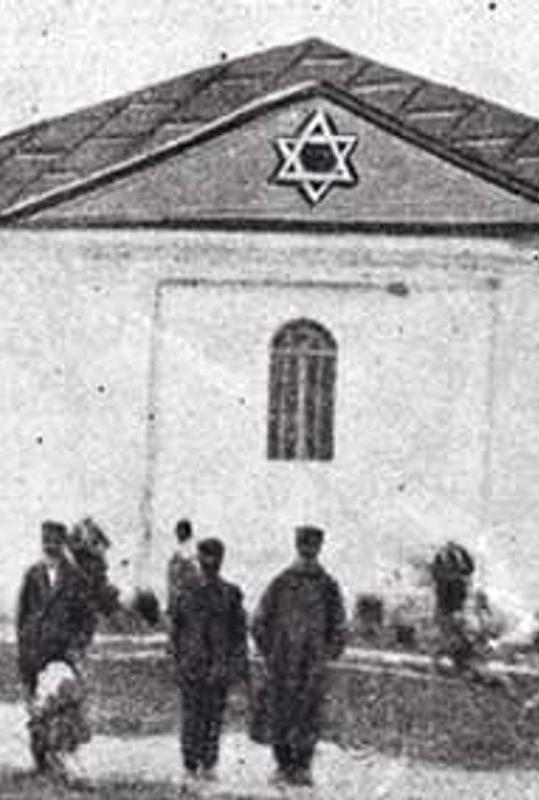
The earliest surviving references to Horodlo date back to 1287.In 1388. By the grant of King Władysław Jagiełło, along with the entire Bełsk region, Horodło became the property of Mazovian Prince Ziemowit IV. It was probably granted city rights in 1432. October 2, 1413. In Horodlo, King Ladislaus Jagiello and Prince Vytautas signed the Polish-Lithuanian union.In the 16th and 17th centuries. Horodlo was repeatedly destroyed by invasions of Tatar armies and fires. In the second half of the 16th and early 17th centuries. Its economic and business development followed, aided by its location at the intersection of important trade routes and the Bug River crossing. There were numerous craft workshops and water mills.In 1706. The city was destroyed by Swedish troops, and in 1850. - fire.In 1869. It lost its municipal rights. At the end of the 19th century. There were a church, an Orthodox church, a synagogue, an early school, a community office and a vodka factory.The port on the Bug River was an important point in the grain trade. During World War II, the Horodlo area was the region of partisan activity of the Home Army.Jews in Horodlo - Until 1918. - The earliest surviving references indicating the presence of Jews in Horodlo date back to 1507. In 1565. were recognized as full-fledged citizens of the city.Most likely in the late 16th century. They established a cemetery, while no later than 1628. They built a wooden synagogue. In 1648- 1649 Khmelnytsky's Cossacks slaughtered almost all the local Jews.The community was revived in the early 18th century. Or in the middle of this century. Horodels Jews made their living mainly from trade and crafts, floating wood to Gdansk, transporting cattle from Ukraine, making and selling alcohol. In 1765. They owned 29 houses and eight stores.There was a wooden synagogue, a beit ha-midrash and a cemetery.In 1850. The old wooden synagogue burned down. In 1865. A brick synagogue was erected in its place. In the mid-19th century., after the old cemetery was taken out of service, a new necropolis was established near the Catholic cemetery on the road to Strzyzow. In the 19th century. The Hasidic movement gained many followers in Horodlo. Most of the local rabbis were followers of tzaddikim from the Izbice-Radin dynasty, while numerous shtibles brought together followers of tzaddikim from Gora Kalwaria, Turzysk and Belz. During World War I, under the auspices of the Jewish Relief Committee, funded by, among other things. by the Joint, a kitchen for the poor was in operation.Interwar period - The community in Horodlo included Jews from several surrounding villages, including. From Strzyżów, from Kowal, Kopyłów and Liski. Most of the Jews made a living from petty trade, including door-to-door trading, crafts (tailoring, shoemaking, carpentry). There were Jewish trade unions, aid and charitable institutions, among others.: Linas ha-Cedek, Hachnoses Orchim and Aguda Naszim.Of the Jewish political parties, the Zionist groups enjoyed the greatest support. In addition to Aguda, the following had representation. General Zionist organization, Poale Zion and the Revisionists.Youth with Zionist views were brought together by the cross-party organization He-Chalutz.The Tarbut Cultural and Educational Association ran a Hebrew school and library. No later than 1937. A new mikvah was built.Holocaust - In October 1939., along with the retreating Red Army, a number of Jews fled eastward from Horodlo. Soon after the occupation of the settlement, the Germans established a Judenrat there.In the spring of 1941. They demolished the synagogue and destroyed the cemeteries.In April 1942. Most of the local Jews (i.e. ca. 680 people) were resettled in the Uchanie ghetto.From there, on June 10, they were sent to the train station in Miączyn near Zamosc. After selection, some people were sent to labor camps, including. in Stawy (near Chelm), the others were deported to the Sobibor death camp. .
1. Horodło - Centrum miejscowości
Stories

Horodło - center of the village
Jewish History Tours
Powered by Clio Muse Tours
Powered by Clio Muse Tours