Jews in Frampol - Until 1939. - The first Jews appeared in Frampol with the location of the town.The oldest surviving source references confirming their settlement date back to 1735/36. On a wider scale, they began to settle here only after the location of the city.When the city was laid out, the Jewish community received kahal land.Probably in the mid-18th century. An independent municipality was formed. The synagogue complex, including the main synagogue, the community beit ha- midrash and the mikvah, occupied the southwestern part of the market buildings.Before 1736. A cemetery was established in the northwestern part of the city, while ca. 1760 r. A synagogue and beit ha-midrash were built.Erected around 1860-1864, the mikvah was the first brick building in Frampol.The Jewish community grew rapidly in terms of demographics - in the second half of the 19th century. Jews already made up more than half of the population.In 1845. A member of the synagogue's supervision was Samson Kahan, and in 1864. - Chaskiel Maller and Haber Flampoler. For forty years (1862-1902) the position of Frampol's rabbi was held by Szyja Hersz Heller.The town was inhabited in 1865. 91 Jewish families - a total of 668 people. The source of income for most was trade and crafts, a few families supported themselves by victualing the Russian garrison stationed in the area, while at the turn of the 20th century. Jewish entrepreneurs took over some of the local weaving industry and tanneries. In the late 19th and early 20th centuries. Branches of political parties were established in Frampol, among which - especially in the years of World War I and immediately afterwards - those with a Zionist orientation and illegal communist organizations gained strong support.Interwar period - In Frampol there were a main synagogue, a communal beit ha-midrash and several private ones, a communal Talmud-Torah and a mikveh. The municipality subsidized the operation of an interest-free loan fund and paid relief payments to the poor.Since 1914. The duties of the rabbi were taken over by the rabbi of Modliborzyce - Hersz Goldsztejn. After 1925., as a result of the growing economic crisis, Frampol's loss of its position as an important center for horse markets and the appearance of competing stores run by Christians in the town, the material situation of local Jews deteriorated. The municipality also faced financial problems - it was unable to finance the activities of its institutions or carry out repairs to the synagogue and mikvah, which were in a state close to a building disaster. It was only in the early 1930s, thanks to donations from former residents who emigrated to the United States, that it became possible to renovate both buildings. Traditional charitable institutions were active - including. Bikur Cholim and Linas ha-Cedek.The Joint provided food, clothing and schoolbooks for the poorest children. The deteriorating economic situation in the late 1920s and 1930s contributed to the mass exodus of Jews from Frampol. Some of them moved to other cities, some emigrated - mainly to the United States. There were numerous organizations, political parties and related social, cultural and educational institutions in Frampol. Various factions of the Zionist parties have gained a strong foothold, including.: General Zionists, Mizrachi, Poale Zion, and the Agudah, which had the greatest influence among members of the Frampol community in the early 1930s. Representatives of the Jewish community also sat on the city council.In the second half of the 1930s, anti-Semitic sentiment increased. In late 1936 and early 1937. In Frampol, there was a boycott of Jewish stores and workshops.Noblista described Frampol this way: "It had everything that should be in any town: a synagogue, a house of learning, a shelter, a rabbi and several hundred residents. Every Thursday in Frampol was market day and peasants would come down from the villages to sell grain, potatoes, chickens, calves, honey and to buy salt, kerosene, shoes and anything else a peasant might need." Isaac Bashevis Singer, Tales of Three Wishes, translated.E. Petrajtis- O' Neill [in:] Isaac Bashevis Singer, Stories, translated. E. Petrajtis- O' Neill and D. Bogutyn, Bis Publishing House, Warsaw 1993, pp. 15. .
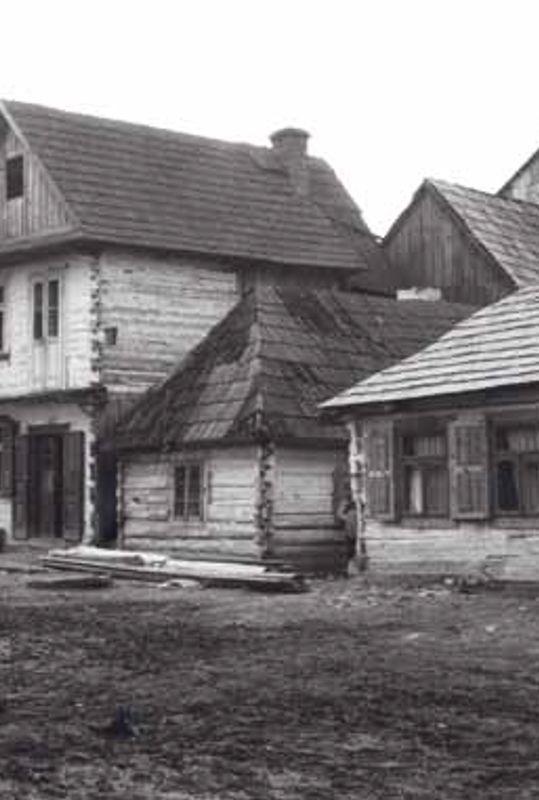
1. Frampol - Centrum miejscowości
Stories

Frampol - center of the village
Jewish History Tours

Powered by Clio Muse Tours
Powered by Clio Muse Tours