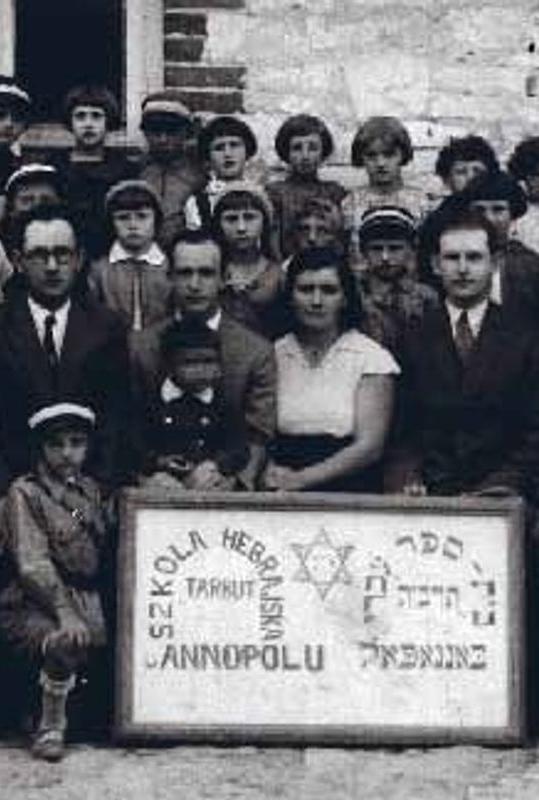
Annopol was located in 1761., by virtue of a privilege from King Augustus III Sas, on land that had existed since at least the 15th century. Rachow village. The new name did not catch on, and by the end of the 18th century., as well as later, the city was called Rachow.In the 18th and 19th centuries. developed as a center for grain trade.In 1870. Annopol lost its municipal rights. During World War I, the battle front between Russian and Austrian troops ran through Annopol and the surrounding area, and in September 1939. Heavy clashes between Polish and German troops took place in these areas. From 1941 to 1943, a German labor camp was located in Annopol. In 1996. The town regained its municipal rights.Under Annopol, there are several kilometers of underground passageways of an underground corridor that has been closed since the 1970s. phosphate mines. Before 1939. Annapolis deposits were exploited by, among others. a company run by Jakub Lejba Rozenberg, the owner of the manor estate in Annopol.Jews in Annapolis - Until 1918. - The oldest documents confirming the presence of Jews in Annapolis date back to the xviii century. It is likely that the first Jews settled here at the beginning of the xvii century.They were mainly engaged in grain and cattle trade, propination of alcohol, leasing inns, salt warehouses and orchards, crafts and usury. In 1712. The landlord in Rakhov was Moszko Izraelowicz.The Jewish community was established between the xvi and xviii centuries. To the northwest of the market was a synagogue square, with a cemetery next to it.In the 19th century. There were already two synagogues - a brick one and a wooden one. At the end of the century, a new cemetery was established outside the borders of Annopol.In the 19th century. The community grew rapidly, while Jews played a significant role in the economic and social life of the center. There were many Jewish artisans (mainly tailors and shoemakers), as well as numerous Jewish stores and manufacturing and commercial enterprises.Annopol's wealthiest citizens funded and financed the Jewish hospital. Following the introduction of tsarist decrees throughout the Kingdom of Poland (1845) on changing the dress of Jews, the Annopol authorities issued a decree forbidding local Jews to wear traditional attire, peyos and beards. Jewish schools and a hospital were closed.The restrictions sparked numerous protests by local Jews, and there were anti-Jewish riots. In addition, as a result of the deteriorating economic situation of the settlement in the late 19th century. Many Jews left Annapolis for larger cities, as well as overseas. Since the beginning of the 20th century. Jewish political parties were formed. During World War I, the local Zionist organizations established and operated the Zionist Library. I. L. Peretz, with an extensive book collection in Hebrew and Yiddish.Interwar period - Annopol was a typical shtetl, inhabited mostly by Jewish people. Despite extremely difficult economic conditions, caused by, among other things. large losses from World War I, the Jewish community grew rapidly in terms of demographics. Among the local cells of many political parties, the Zionist organizations enjoyed the greatest public support, the Agudah had a strong presence, and in 1928-1929 the Communist Party. Of great cultural significance was the Hebrew school of the Tarbut network.Its graduates were active in the local Zionist youth annexes in the 1930s, including the Tarbut School. Ha-Shomer ha-Cair and He-Chaluc ha-Cair. Many of them emigrated to Palestine before the outbreak of war.Among the schools providing education at the elementary level, cheders, secular Jewish schools for girls and boys, and a communal Talmud-Torah were numerous. Graduates of cheder or Talmud-Torah continued their education in a small yeshiva.In the second half of the 1930s, as a result of the progressive economic crisis and the rise of anti-Semitic sentiment, the economic situation of Annapolis Jews gradually deteriorated. Those in financial distress received assistance from numerous charitable institutions: since 1920. A relief and loan fund operated here, and since 1925. cooperative bank. In the 1930s, anti-Semitic incidents occurred in Annapolis.Holocaust - Soon after the outbreak of war, many Jewish refugees from other towns and cities arrived in Annopol.The Germans established an open ghetto. In May 1942. It housed nearly 2,000 people, including, among others. Jews from the surrounding villages, as well as from Kalisz, Lodz and Krakow. The Judenrat was headed by the chairman of the pre-war Jewish community council, Binem Mandelkern.The liquidation of the ghetto began on October 15, 1942.After an initial selection of approx. 400 people were sent by the Germans to labor camps in Gościeradów and Janiszów. They murdered the elderly and infirm on the spot, and deported the others to the Kraśnik ghetto, from where they transported them to the Belzec death camp on October 18. Several men who escaped from Annopol before the deportation action began hid in the surrounding forests.During the occupation, the Germans destroyed synagogues and devastated cemeteries.
1. Annopol - centrum miejscowości
Stories

Annopol - the center of the village
Jewish History Tours

Powered by Clio Muse Tours
Powered by Clio Muse Tours