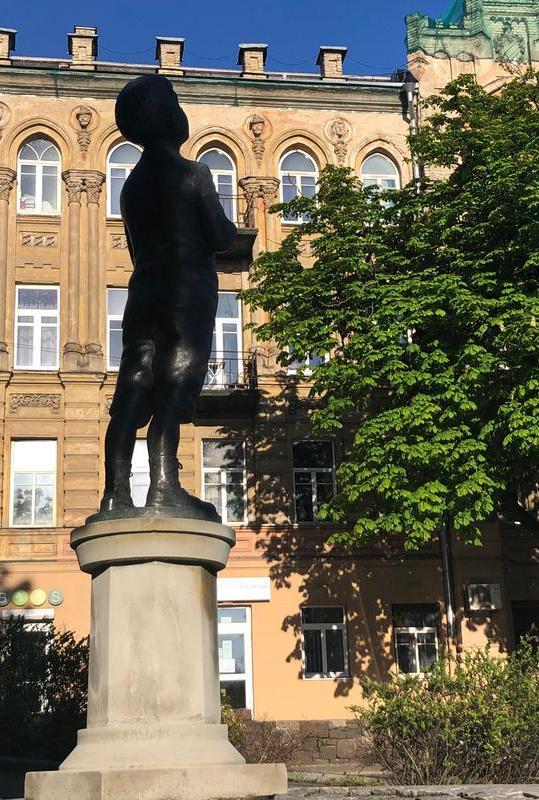
"His life is his work, and his work is his life" – is how we could describe Romain Gary (1914-1980) also known under the pseudonyms of Émile Ajar, Shatan Bogat, Lucien Brûlard, René Deville and Fosco Sinibaldi. There are fewer credible facts about his life than of those he came up with while writing and giving interviews to the mass media. To us he is known as Romain Kacew, born on the 8th of May 1914 in Vilnius, in the family of Trakai Second Guild merchant Leib Kacew and Mina Owczynska Bregsztejn. There is little information regarding his childhood – the family soon separated, and Mina’s life path, and probably her son’s, oscillated back and forth between Poland and Russia. Only in 1921 did Mina, together with Romain, settle for a longer period in Vilnius, in apartment number 4, at 16, Great Pohulanka Street (Pl. Wielka Pohulanka), which today is 16, J. Basanavičiaus street.
15. Romain Gary
Stories

Romain Gary, Roman Kacew, Émile Ajar
Emigration to France
Romain only spent four years in Vilnius with his mother – in 1925 he left for Warsaw, and three years later – onwards to Nice. It seems that the reason for such restlessness was poverty. Mina Kacew indicated to the commissioner of Warsaw that, abandoned by her husband, she could not sustain herself with the alimony he paid – 250 zloty per month, therefore she was forced to go abroad to earn income. Another reason might have also impelled the relocation – Mina was convinced that her son was a genius, thus she sought a better education for her child and encouraged his creativity. Whilst living in Vilnius, Romain was already attending singing classes and learning languages, but everything turned out quite differently than was expected. In 1935 he enrolled to study law at the University of Aix-en-Provence. Later on, he studied in Paris, attended courses in the Higher military training school, and in 1938 to 1940 he studied in the military aviation school in Salon-de-Provence. He was awarded the Legion of Honour Order after his successful participation in air raids during the Second World War. After the war an exciting and successful career as a diplomat awaited Romain.
Fulfilling Mother’s Dreams
Nonetheless, his mother’s insight into the nature of her child was correct. It was not until 1962, after having lived through almost half of his life, that Gary completely devoted himself to literary work. He managed to publish more than 50 works, also direct two movies, and be awarded the prestigious Prix Goncourt twice – even though this prize is usually awarded to writers only once during their lifetimes.
Émile Ajar
For Gary, literature was as a game in which he juggled the various episodes of his life, changing and moulding them, creating fictional stories, and presenting them as facts in his biography. Eventually, his literary stories intertwined with facts about his actual life to the extent that he decided to play the greatest trick of his life. He was motivated by gossip that spread among the milieu of Paris litterateurs. It was alleged that, after winning the Prix Goncourt for his piece “The Roots of Heaven” (Fr. Les Racines du ciel), his talent started to dwindle. Gary hired a relative to act as a deranged writer called Émile Ajar, and using his name Gary presented a new piece in 1975 “The Life Before Us” (Fr. La vie devant soi). The latter work brought Gary yet another Prix Goncourt award. The truth emerged only in the text “The Life and Death of Émile Ajar” (Fr. Vie et mort d'Émile Ajar) which was published only after the death of Gary. With this well-considered gamble Gary sought to stir the stagnant and closed off society of the Paris litterateurs who viewed Gary’s success with suspicion, and considered him a sentimental mediocrity who lacked expression. And they were proven wrong by Gary’s creation – Émile Ajar.

Powered by Clio Muse Tours