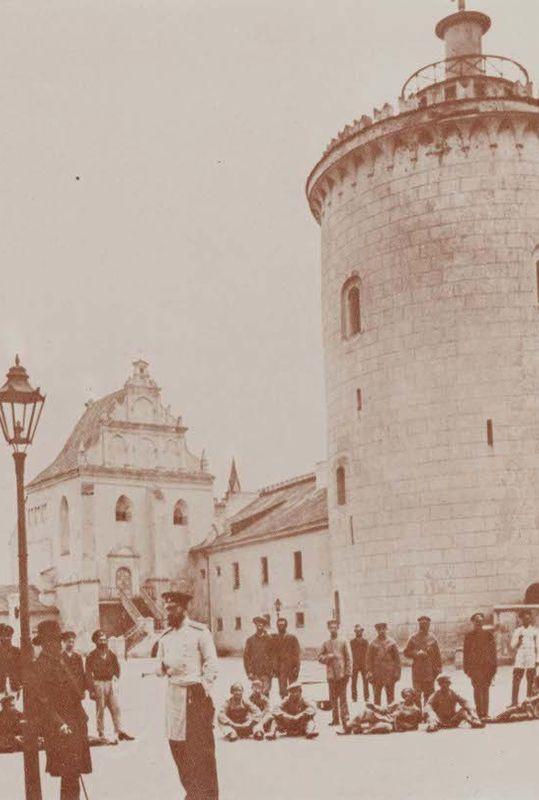
The castle dates back to the Middle Ages. Its oldest parts are the 14th-century tower with an observation deck and the 15th-century Chapel of the Holy Trinity, created at the initiative of King Władysław Jagiełło (1362-1434), the founder of the Jagiellonian Dynasty. The chapel features unique medieval frescos that inscribe Byzantine tradition into Gothic architecture. It was under Jagiellonian rule that Lublin experienced its golden era and the Lublin Jewish community earned its world renown.On 2 February 1386, the nobility of the Kingdom of Poland, in accordance with the prior arrangements made in Krewo (modern-day Kreva in Belarus), elected Jogaila (later Władysław Jagiełło), the Grand Duke of Lithuania, to be their king, and consented to his marriage with Polish Queen Jadwiga. The wedding took place in Krakow two weeks later and marked the beginning of the Polish-Lithuanian Union that was to last four hundred years. From now on, Lublin, conveniently located on the route between the two capitals, Krakow and Vilnius, became a site of important political events and a trade centre. Another Polish-Lithuanian Union, the so-called Union of Lublin, was signed in the city in 1569, during the reign of Sigismund Augustus (1520-1572), the last king of the Jagiellonian Dynasty. It merged both countries, hitherto only in personal union, into one state.The castle was devastated during the invasion of the Muscovite army in 1656. It was rebuilt in its current neo-Gothic shape only after 1815 to be used as a prison. Today the castle houses the National Museum in Lublin, which exhibits various artefacts related to the history of the city and the region, including an interesting collection of objects from synagogues and paintings by Jewish artists born in Lublin, such as Symcha Trachter (1894-1942) and Henryk Lewensztadt (1893-1962). The Museum also displays the painting Reception of Jews in Poland (1888) by Jan Matejko.
3. Zamek - Muzeum Narodowe w Lublinie
Stories

Castle
Navigational story for Castle - National Museum in Lublin
Parallel to Szeroka Street, but closer to the castle, ran Castle Street and Podzamcze Street, which intersected with it, surrounding the castle from the south. On the western side stretched Nadstawna Street, called Cheder Street, as it housed many schools for Jewish children. The houses of prayer of Hasidic Jews from Góra Kalwaria and Kazimierz Dolny were also located there.Although Lublin was known as a "fortress of Orthodoxy," from the end of the 19th century, new currents - socialism and Zionism - gained increasing importance here as well. At the intersection of Nadstawna and Kowalska Streets there was a large empty square where rallies and political gatherings were often held.In the 1930s. In the 1920s, between the numerous houses of prayer, on Szeroka Street, there was also the secretariat of the Bund party, the trade unions associated with the party, and the Lubliner Sztyme newspaper. The workers sang their songs with growing pride and joy, and whenever eight or nine gathered, a tenth would invariably spring up from somewhere to preach to them, always beginning with, "Comrades and citizens." Elderly Jews, passing such gatherings, would mutter disapprovingly under their breath, "If things don't get better, they'll surely get worse."Jacob Glatstein, The Glatstein Chronicles - Homeward Bound, 2010 (Ven yash iz geforn, 1937) .

Powered by Clio Muse Tours