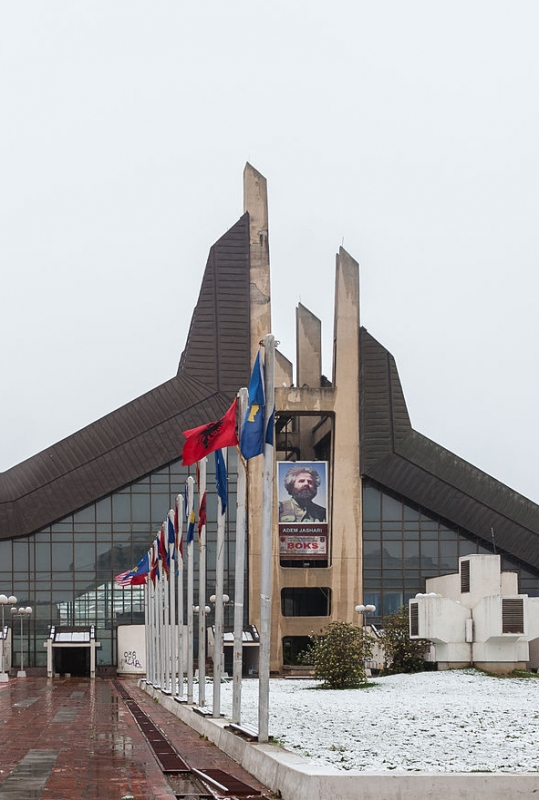
Your tour will start at the Youth Palace ´Boro and Ramiz` which is at the very center of Prishtina. It is located some 100 meters from the Grand Hotel towards the north-west which is the iconic symbol of the central part of the city. You will recognize the Youth Palace by its characteristic architecture. The bus line nr 4 will take you from near the Central Bus Station or from “Rrethi.”
1. Youth Palace `Boro and Ramiz`
Stories
Directions
A former symbol of Brotherhood and Unity
The Youth Palace ‘’Boro and Ramiz’’, named after the two WWII partisan heroes, is a futuristic building with harsh lines that operates as a sports and cultural center. It has 8 mainframes symbolizing the 8 federation units of Yugoslavia and it is divided into two wings symbolizing Brotherhood and Unity. It was designed by Zivorad Jankovic and Halid Muhasilovic and built between 1975 and 1977 at the request of the inhabitants, following a referendum held in the city in 1974. A constrained renovation took place in 2000 after a fire that destroyed the building partially. The ‘’Brotherhood and Unity’’ was the main ideology and strategy inspired by Tito in the former Yugoslavia and the construction of Pristina’s youth palace is among the several buildings created to serve this cause. Nevertheless, after the 1999 conflict, all the monuments dedicated to Boro and Ramiz were renamed or destroyed, Boro being considered as an "enemy" or as the "Serbian". Officially the building is the Youth and sports palace although some inhabitants still call it Boro-Ramizi.
The two heroic partisans
Boro Vukmirović (an ethnic-Serb) and Ramiz Sadiku (an ethnic-Albanian) because of their participation in the Communist Party, developed a strong friendship. While in 1941 they both collaborated in organizing the Partisan uprising against Italian occupation in Kosovo and Albania. On April 7th of 1943, while they were traveling from Dakovica to Prizren they were captured east of Landovica. They were tortured but had refused to give up information. Then the Axis troops decided to execute them. Boro and Ramiz embraced each other tightly and refused to separate. They were thus shot together and both shouted slogans supporting the Partisan movement. During the Yugoslav era pupils in Kosovo used to learn a patriotic poem, taught both in Serbian and Albanian, about two heroic partisan soldiers who fought against the fascist occupation. The ‘’two bodies of the same blood’’ as referred to in the poem was capturing Tito’s national ideology of ‘’Brotherhood and Unity’’. Nevertheless, Boro and Ramiz’s story is considered controversial and there are allegations that it was constructed by communist partisans.
The national hero Adem Jashari
Adem Jashari was born in 1955 in Prekaz, a region of the Socialist Autonomous Province of Kosovo. From the very beginning Jashari fought against Serbs and he was among the other ethnic Albanians that were in favor of Kosovo’s independence from the Federal Republic of Yugoslavia. Due to the fact that he was one of the founders of the KLA (the Kosovo Liberation Army) and as a commander, he organized numerous attacks against the Serbian authorities. He managed to avoid being captured by the Serbian police many times and he was sentenced to terrorism in absentia by the court. In 1998 after a massive attack in his hometown, Jashari and many of his family members were killed. Following his death, he was considered as Kosovo’s national hero and after the declaration of independence in 2008 many public buildings were named after him. The youth palace was among them, and that’s why a large size portrait photo stands in the entry; however, despite this attempt, the new name didn’t prevail.

Answer this!
Who were Boro and Ramiz?
A
Two heroic partisans
B
Two school friends
C
Tito’s colleagues
D
The Youth Palace
RePAST H2020 Project

Powered by Clio Muse Tours
Powered by Clio Muse Tours