In the middle of the 4th century BCE, on a large plateau at an altitude of 650m a new city-state appears. It is Cassope, the political, religious, and financial center of the Kassopaeans, one of the numerous tribes that inhabit ancient Epirus. The citizens of Cassope prosper. A century after the city was founded there are almost ten thousand people living there. They are farmers and shepherds, potters or smiths, traders or sailors in the Ambracian Gulf and the Ionian Sea. Life ends abruptly though. Cassope was abandoned in 31 BCE when the inhabitants resettled to Nikopolis on the orders of emperor Augustus.
15. Ancient Cassope
On the slopes of the Zalongo mountain, among towering pine trees, lies an ancient town. It enjoyed its residents only for a little while. She was forced to bid them adieu and remained alone.
Stories

Imperial immigrants
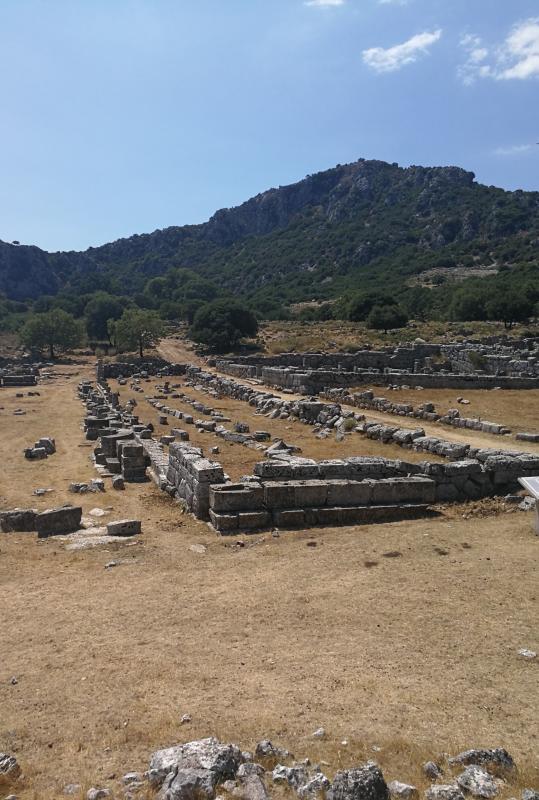
A mysterious building
The heart of Cassope beats in the agora, much like in any other ancient Greek city. Here is the political, religious, and administrative center where the citizens gather to vote, confer, discuss, participate in trials and religious ceremonies. Among the other buildings of the agora stands a two-storey square edifice with a central courtyard and a roof covered with tiles. On all four sides there are porticos and rooms. What was it used for? The archaeologists don’t have a ready answer. Perhaps it was a public hostel for honoured guests and representatives of other city-states. Perhaps it was a shopping mall and each room was a store with its own storage room on the first floor.
An exemplary city
Cassope was designed along geometric lines. The urban planners created parallel roads approximately 30 m apart. These were intersected by broader roads, forming approximately 60 blocks with the same width but different length. Each block was occupied by two private residences that covered an area of 220 square metres each for a total of 600 different houses within the city walls. They all had two storeys, faced south, and were well-built. They also had an excellent sewage system for domestic waste and rainwater. Pouqueville, the French consul in the early 19th century noted that “the study of the ruins...is as interesting as the study of Pompeii and Herculaneum”.
A theater with a view
The large theater of Cassope was constructed in the 3rd century BCE in a hill. It had a capacity of about 6,000 people who could enjoy the spectacles offered by the city. They would also definitely enjoy the panoramic view that enables them to see Preveza, the Ionian Sea, the Ambracian Gulf and the coast of Akarnania. The theater fell silent along with the entire city at the end of the 1st century BCE. The passing centuries, natural decay and the tumbling rocks from the hill above turned it into a vast ruin. Today, more than twenty centuries since it was abandoned, the theater of Cassope comes back to life with a comprehensive restoration programme that will enable spectators to sit in the auditorium and enjoy the spectacular view.
Nea Odos

Powered by Clio Muse Tours
Powered by Clio Muse Tours