Towards the end of the 17th century Venice embarked on a policy of harassment towards the Ottoman Empire; armed groups would infiltrate the Ottoman territories and plunder the wealthy communities of Epirus. In 1696 the Maniot pirate Liverios Gerakaris attacked the town of Arta and the neighbouring villages; he got away with a fortune! Many communities in Tzoumerka agreed to pay an annual tribute to Venice in order to protect themselves from these depredations. Mesounta was one of the villages that agreed to pay the tribute in 1695. It must have been a fairly prosperous place by then, and remained so for some time, since Ali Pasha of Ioannina made sure to gain control over it.
16. Mesounta | Where a rebel met his end
Mesounta is not as old a village as others in Tzoumerka. It is famous, nevertheless, as the site where one of the seminal figures of twentieth-century Greek history met his violent end.
Stories

The long arm of Venice
The general
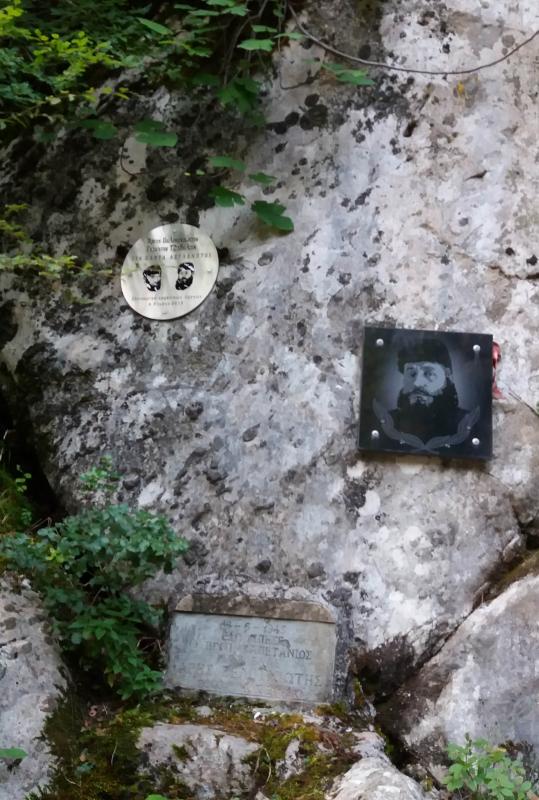
Mesounta is famous as the site where Aris Velouchiotis, a prominent and successful generals of the National Liberation Front (EAM), which was the major resistance organization in occupied Greece from 1942 to 1945, met his violent end. Velouchiotis won several battles against the Germans, the Italians, and Greek collaborationist military groups during the Second World War. When the Germans evacuated Greece in October 1944, the British landed their forces in Athens to secure the capital on behalf of the Greek government. Months of tensions between them and the communists resulted in the Dekemvriana, a series of clashes in Athens in December 1944. The communists were defeated and signed the Varkiza Agreement that demanded their demobilization.
The suicide
Velouchiotis refused to comply with the Varkiza Agreement and moved to the mountains of central Greece in order to start a new resistance movement. The Communist Party denounced him as a traitor, while the Greek army sent units to hunt him down. Many of his associates abandoned him, but he was able to conduct guerrilla activities until June 1945. Then he was surrounded by the government forces near Mesounta. He was trapped and outnumbered, so he chose to end his life rather than being captured. He shot himself in the head, while one of his comrades committed suicide by a hand grenade. When his body was discovered, the head was cut off and displayed in the central square of the town of Trikala.
Nea Odos

Powered by Clio Muse Tours
Powered by Clio Muse Tours