The enmity between Ali Pasha of Ioannina and the Souliotes was longstanding. The ruthless ruler had tried for many years to subdue Souli but military campaigns always ended in abject failure. In 1800 Ali adopted a new method; he bribed various Souliotes and divided their leadership. Georgios Botsaris, head of one of the most powerful clans, refused to share the bribe with the other clans and left Souli. Ali allowed him to settle in Vourgareli with another 170 families. When Souli fell (1803) only a handful of survivors managed to reach Vourgareli. Botsaris realised that Ali would soon turn against him and fortified the Seltsou Monastery, east of the village. In January 1804 the Turks attacked and massacred most of the Souliotes. Only 60 men and a woman survived.
15. Vourgareli
Vourgareli may derive its name from a local lumberjack, or a group of Bulgarians who settled here before 1696. It rose to fame through the flames of war, whose wrath descended on the village again and again.
Stories

The last Souliotes
The bombardment
The National Republican Greek League (EDES) was a large non-communist resistance group during the Axis occupation of Greece during the Second World War. It concentrated its activities in Epirus and Vourgareli served as its headquarters since April 1943. Soon, this “capital” of mountainous Greece attracted the attention of the German authorities. On the morning of 5 May 1943, the German air force attacked; dive bombers unleashed more than 400 bombs against Vourgareli. The villagers tried to escape in the surrounding woods but the German guns followed them there with deadly accuracy. The victims included 13 dead and 30 injured, while many houses were completely destroyed.
Birthplace of a revolution
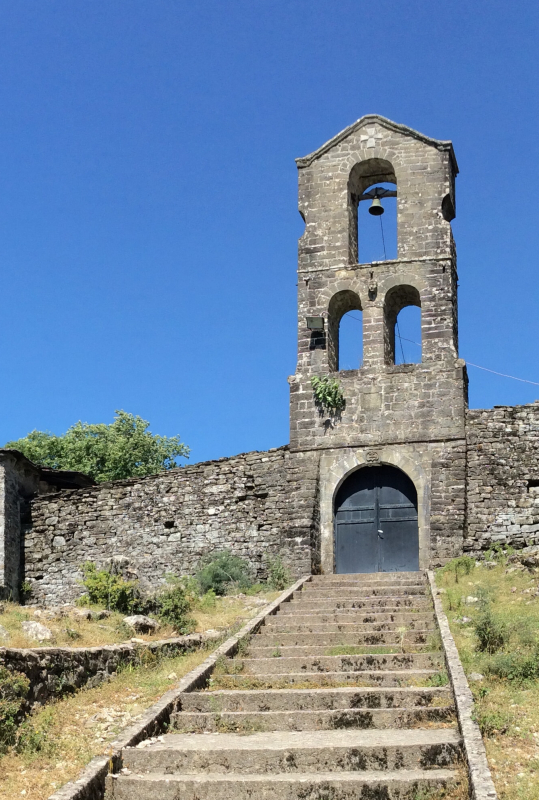
The Greek Orthodox monastery of Saint George was erected on the village’s highest point, either in 1690 or 1714. The catholicon (main church) and the cells survive in excellent condition, though the latter are newer additions. The catholicon is a one-aisled basilica with a dome; the walls are covered with frescoes dated in the early 18th century. Strong abutments reinforce the stability of the long walls of the church. The monastery is famously linked with the Greek War of Independence, since tradition claims that it was here that the abbot raised the revolutionary flag in the presence of the local military leaders Georgios Karaiskakis, Gogos Bakolas and others in the spring of 1821.
Powered by Clio Muse Tours