In late 1823 Lord Byron, the most famous poet of his time, decided to abandon a life of pleasure in Italy to help the Greeks liberate their country from the Ottomans. Byron had been to Greece once already and had been delighted by the climate, the beauty of the people and the landscape. On the other hand, he had become familiar with the national character of the Greeks and held a very low opinion of their ability to win their freedom. He knew that rival chieftains and politicians were loath to support a central government, a fact amply demonstrated by perennial feuding while the enemy was still undefeated. Nevertheless, Byron felt he could do some good and in January 1824 he landed at Missolonghi.
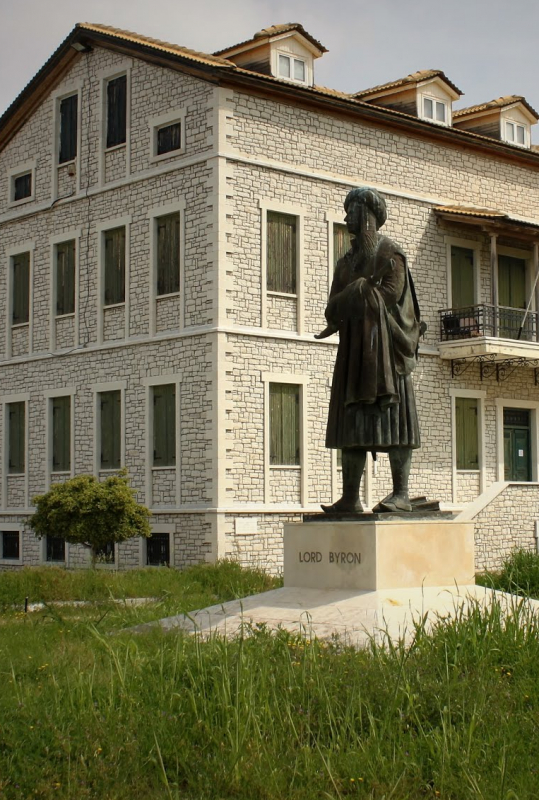
1. Missolonghi Byron Society
A piece of land with a most glorious past. On this site that was once on the shores of the lagoon, stood the house where Lord Byron lived and died in the cause of Greek independence.
Stories

The great poet
War room
The house selected for Byron was down on the shore. It was most definitely Turkish in its appearance, with projecting balconies, exterior staircases, relatively small windows and numerous open turrets. The ground floor was soon full of Byron’s boisterous band of Souliotes, whom he employed as his personal bodyguard. The outhouses served as stables. On the first floor Colonel Leicester Stanhope planned a newspaper, called “Hellenica Chronica” (Greek Chronicles); Byron financed this endeavor as well. The second floor walls were covered with swords, pistols, sabres, bayonets, and helmets. Here Byron planned military campaigns and had an expansive view of the lagoon.
Last birthday
On January 22, just a few days after he landed in Missolonghi, Byron came from his bedroom into the public area to announce the composition of a poem to celebrate his birthday. It was called “On this Day I Complete my Thirty-Sixth Year” and according to Byron’s own words, it was better than what he usually wrote. The famous final stanza (Seek out—less often sought than found— / A Soldier's Grave, for thee the best; / Then look around, and choose thy Ground, / And take thy rest.) may be a reflection on his concerns about the effects of time on his own beauty; he was going bald, he had gained weight, and his teeth were decaying. Better to seek a glorious death than fade away in old age.
Twelve leeches
Byron was not destined to enjoy a glorious death in battle. On February 15 he suffered a serious and painful seizure that left him speechless and with his features distorted for some time. Fever and pain plagued him for days and by April 10 he was no longer able to stir. His four doctors seemed unable to offer any assistance other that excessive bloodletting with leeches, which only made matters worse by weakening the poet’s exhausted body. While he worried about his dependents, his household was falling into total disarray. Eventually Byron lost all consciousness (during his last hours of conscience he seemed to imagine that bullets were flying round his head) and died on April 24, 1824.
Nea Odos

Powered by Clio Muse Tours
Powered by Clio Muse Tours