During the interwar period tobacco was one of Greece’s main exports, but its rise to such an important position was slow at coming. Initially, tobacco was grown in relatively small quantities in three or four areas of Greece (Agrinio being one of them) to satisfy domestic demand. All this changed after the upheavals of the 1912-1922 period, a decade during which Greece was almost always at war that ended with the Asia Minor disaster. The annexation of Macedonia and Thrace, as well as the arrival of 1.5 million refugees created a new dynamic in the cultivation of tobacco. The new regions were well-known for their tobacco, while many refugees specialized in tobacco farming.
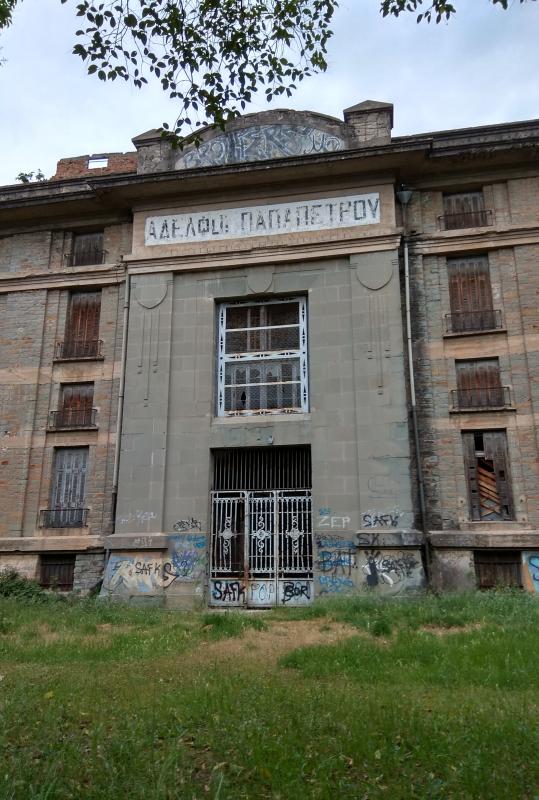
2. Papapetrou Tobacco Warehouse
The tobacco warehouse was not just an industrial building. It was also a statement of modernity, influence, and wealth, as well as a conduit for the introduction of new ideas and technologies.
Stories

Growing tobacco
What goes up must come down
Tobacco was an ideal crop for a country full of small landowners and destitute immigrants. It yielded four times more income than any other product per hectare of land, secured large volumes of foreign exchange from new markets (mainly Germany) and was an important source of tax revenue in the state budget. Approximately 150,000 families were employed in growing tobacco, meaning that 15% of the country’s rural population depended on it for their livelihood. In Agrinio it was the only crop and served as a source of wealth for the entire population. So the collapse of its price as a result of the financial crisis of 1929 reduced standards of living and gave rise to social unrest.
A touch of Europe
The production and export of tobacco required the construction of warehouses for the processing, sorting, and baling of the product. Ideally, these warehouses would be located near railway stations and would have easy access to the rural hinterland where the crop was grown. The Papapetros tobacco warehouse is a typical example of these industrial buildings. It occupies a large lot along major thoroughfares and is easily accessible from the railway station. It was built with a structure of concrete in conjunction with visible stone masonry (local gray rock in accordance with the tradition of Agrinio). The main entrances are decorated with sculpted art deco stonework. The whole building is reminiscent of the architecture of Central Europe in a deliberate attempt to promote the company’s European image.
The typical warehouse
Tobacco warehouses were not used for cutting tobacco or making cigarettes and cigars. They were simply intermediary stations in the long journey of tobacco from the field to the factories in Europe where it was processed into finished consumer products. The Papapetros warehouse contains areas for storing the bales purchased from the producers, humidifying areas, salons where the tobacco leaves were graded for quality and processed, areas in which specialized staff blended leaves from different regions according to their variety, areas for commercial packaging, and administration offices. The salons were located on the top floor, where large windows made processing easier, while the lowest level was reserved for storage.
Terrible timing
The use of reinforced concrete in the Papapetros warehouse introduced this material to the city’s architecture. The Papapetros business prospered for a few years but the crash of 1929 hit the company (and Agrinio) very hard. The price of tobacco collapsed and so did export volumes. During the Second World War the Germans used it as a prison for Jews from Arta and Ioannina (on their way to the Auschwitz concentration camp) as well as Italian prisoners of war, once Italy surrendered to the Allies in 1943. In the 50s it housed the school of the gendarmerie, in the 60s and 70s it served as a warehouse for olives and tobacco (under new owners) and it was finally abandoned in the 1980s.
Nea Odos
Powered by Clio Muse Tours
Powered by Clio Muse Tours