The castle of Saint Andrew was built by the Ottomans to compensate for the destruction of the castle of Bouka. Since the treaty with the Venetians prohibited the erection of new fortifications on the old site, the new rulers of Preveza built their stronghold one kilometer to the north, at a site called “At the Cypress”. The name was due to an impressive cypress tree, though no trace of it remains. The castle was called Ic Kale (inner acropolis) and consisted of four bastions, one at each corner of the castle, a small stone wall, and wooden poles embodied in it. The Venetian authorities, who kept an eye on what the Ottomans did, where not too impressed by this weak fortification.
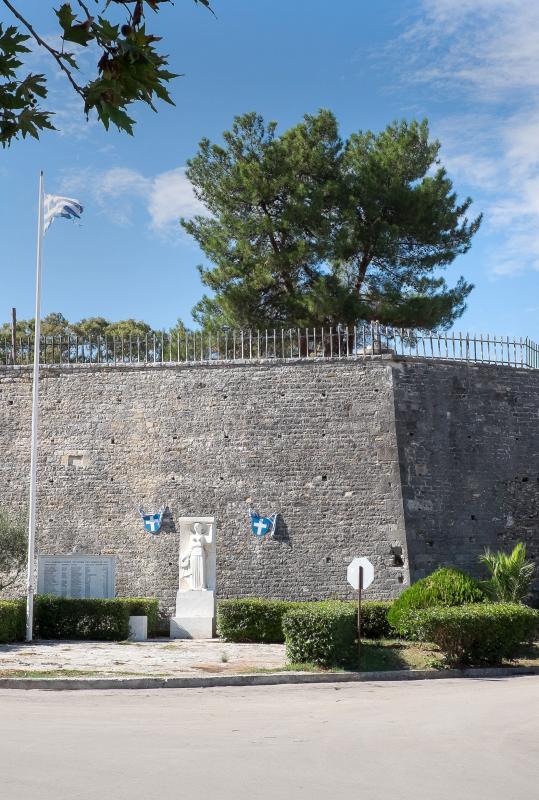
4. The castle of Saint Andrew
The castle of Saint Andrew dominates the city from the top of a low hill for the past three centuries. It is a monument that bears the scars of all the conquerors and liberators of Preveza.
Stories

The cypress
The admiral’s patron saint
The castle soon became the core of the new town of Preveza. People needed security in times of war, so it was only natural that they would leave their old settlement near the castle of Bouka, and set up home near the walls of the new fortification. The Ottomans had hardly finished working on it when the castle of Saint Andrew fell to the Venetians in 1718. They immediately embarked on a project of upgrading its defensive capabilities. They reduced its size to almost half and constructed a new moat. They also converted the mosque in the center of the castle into a Catholic church, in honour of Saint Andrew, the patron saint of the Venetian admiral who captured the town.
Peter and the castle
When Ali Pasha conquered Preveza, in 1807, he proceeded rapidly with the restoration of the castle, that was lying in a ruinous state as a result of many years of neglect. He employed hundreds of Christian workers under the supervision of his favorite architect, a man from Korçë called Peter, to improve the bastions, rebuild the stone walls, and widen the moat. He commemorated the work with a stone inscription, above the monument to the Greek war dead in the southeast bastion. The inscription carries the Arabic phrase “Masha' Allah” ("God has willed it") and the Islamic date 1223 (which is the year 1808 in the western calendar).
Bombs and barracks
A whole series of disasters struck the castle of Saint Andrew in the 20th century. The eastern walls (towards the sea) were demolished in the late 19th century to make room for upscale mansions. When the Greek army liberated Preveza (1912), they expanded the barracks and turned the mosque into an archaeological museum. It was destroyed during a bombardment by the Italians in 1940. In September 1944, communist guerrilla fighters captured the fort and fought against their right-wing opponents, who used mortars in an effort to dislocate them. The castle housed the Greek army until 2000 but is now semi-abandoned. The monument to the people of Preveza who lost their lives in the conflicts of the last century bears testament to the region’s turbulent past.
Nea Odos

Powered by Clio Muse Tours
Powered by Clio Muse Tours