In late summer, or early fall 1292, the Byzantine emperor Andronikos III Palaiologos decided that it was time to bring to heel the rebel ruler of the Despotate of Epiros. According to his plans, his army would attack Ioannina by land, while a naval force would conquer Arta. Unfortunately, Andronikos had dismantled the Byzantine navy a few years ago, so he had to hire Genoese ships. His marines landed in Preveza, where there was no permanent settlement, looted the surrounding countryside, and then moved on to Arta, where they failed to achieve their objective.
3. The castle of Bouka
Preveza’s first castle. It was built by the Ottomans at the entrance to the Ambracian gulf (bouka = entrance) when there was nothing but fields all around. History has come full circle and fields have reclaimed the land.
Stories

Fruitless in Preveza
Dreaming of Italy
In 1463 the Ottomans secured the control of the region around the entrance to the Ambracian gulf. There was still no settlement called Preveza. Mehmed II was eager to conquer the Ionian islands and (perhaps) invade Italy, so he invested heavily in the defences of the gulf, since the Ottoman navy would use it as a base of operations. The Ottomans erected the castle of Bouka (from a word meaning “entrance”) next to the sea. The stone walls were reinforced with seven large round towers, while a wide trench protected the castle from the north. There were also numerous buildings within the walls, while a small town (Preveza) developed along the coastline to the northeast.
What goes up must come down
The Venetians conquered Preveza in 1684, but less than two decades later they were forced to return it to the Ottomans. The agreement stated, though, that they had to evacuate and demolish the castle of Bouka. The Ottomans invited the people of Preveza to remain, but most of them departed with the Venetians and settled in the island of Lefkas. It took the Venetians thirty days to complete the destruction of the towers and the walls. Some of them were blown up with gunpowder, while other parts of the castle were bombarded with cannonballs. Some towers were completely destroyed, while others only partially. The ruins remained lying on the ground for more than a century.
Ali Pasha’s palace
In the early 19th century, Ali Pasha of Ioannina decided to built a grand saray on the land formerly occupied by the castle of Bouka. The site offered magnificent views and there was abundant building material available. Ali added a new trench, that isolated his residence from the town of Preveza, and a redoubt on the seaward side. In 1820, Selim, his son, burned down the saray to prevent it from falling into the hands of the Ottoman forces, that were trying to arrest his father. Before the flames consumed the building, he secretly carried his treasure to the island of Lefkas, where treasure hunters spent the next 150 years looking for it in vain. Today the site of the castle is overrun by eucalyptus trees and grasses, with the occasional ruin lying here and there.
War
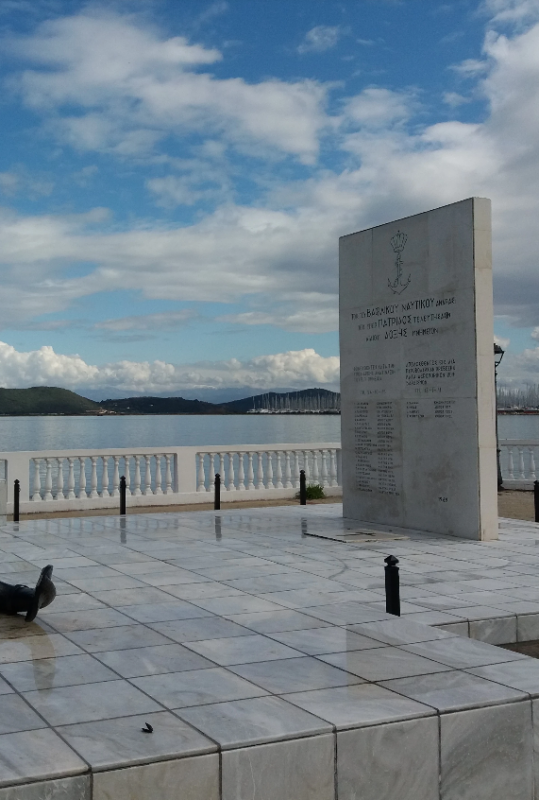
On the morning of October 28th, just hours after Italy declared war on Greece, the Italian air force bombarded Preveza. One bomb destroyed the archaeological museum and another landed in a coffee shop, fortunately without exploding. Over the next few months, as the Greek army pushed the Italians back towards Albania, the town was bombarded repeatedly (more than 100 times). On January 13th, a bomb killed four men of the Hellenic Naval Anti Aircraft battery on this spot. Almost five years later, on October 24th, 1945, the minesweeper “Pineios” struck a mine, as she was attempting to clear the entrance of the Ambracian gulf, and went down with the loss of 22 crew members near the same spot.
Nea Odos

Powered by Clio Muse Tours
Powered by Clio Muse Tours