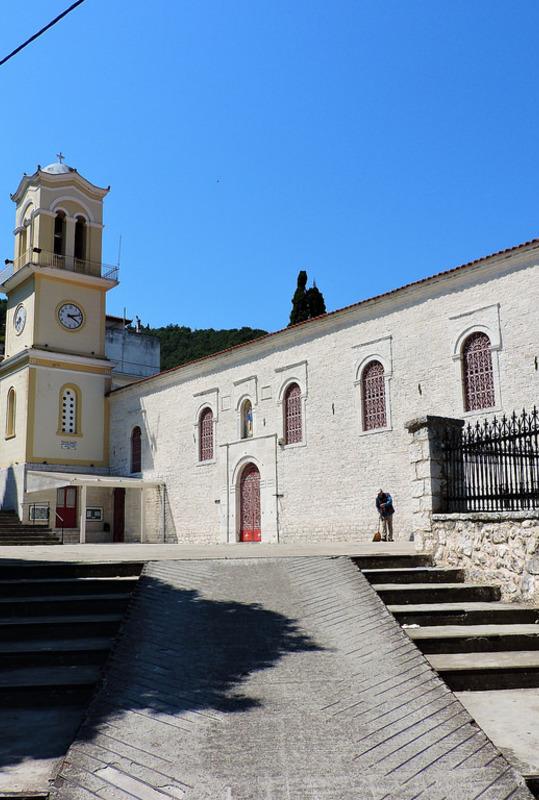
The church of Hagios Athanasios formed the nucleus for the development of the community following the departure of the Ottomans in 1829. Initially there were fewer than 200 residents, soon though the population increased with an influx of immigrants from Epirus, a region that was still under Ottoman rule. The new residents created the necessary conditions for rapid urban growth. The city received a new urban plan, new roads, bridges and a central square. There were even some luxurious coffee houses with Italian and German singers. In 1884, Demetrios Vikelas (the future president of the International Olympic Committee) described Karvasaras as the gateway to a higher civilization.
4. The church of St. Athanasios
The parish church of Hagios Athanasios formed the nucleus of the future community as it expanded and evolved into a vibrant town near the borders of Greece at the time.
Stories

Gateway to higher civilization
Does Jesus exist?
The old church of Hagios Athanasios soon proved too small for the needs of the community, so in 1868 a new church was built on the foundations of the old one. It is a three-aisled basilica with an impressive iconostasis (a wall of icons and religious paintings), a carved wooden episcopal throne, and notable religious relics. The church was dedicated to Athanasius of Alexandria, who at the age of 33 became the 20th bishop of Alexandria in Egypt. He played a pivotal role in the fight against Arianism, a concept which asserts the belief that Jesus Christ is the Son of God and was begotten by Him at a point in time. Therefore Jesus is subordinate to the Father.
Costumes for dowries
The church of Hagios Athanasios is notable for the paintings by Charalambos Pachis (1844-1891). He was born in Corfu and was serving a wealthy Englishman who noticed his skill in painting and financed his art studies in Italy. After spending many years abroad, Pachis returned to Corfu, where he founded a private art school. His students include many notable painters of the Heptanese School of painting. Pachis had a huge collection of costumes for use in his classes, but he sold it to provide dowries for his daughters. He was mostly inspired by famous historical events, which he depicted on canvas.
Ecce homo
The most famous painting by Pachis in the church is “Ecce homo” (Behold the man), inspired by the Latin words used by Pontius Pilate when he presented Jesus Christ to the crowd before His Crucifixion. Christ is shown wearing a white loincloth and the purple cloak of the Roman army. He is invested with the crown of thorns, his wrists are tied, and he is holding a reed sceptre. This particular religious scene was widely depicted in Christian art since the Middle Ages (though it first appeared in Byzantine Syria). The motif of the lone Christ, who is staring directly at the observers, enabling them to identify with the deeper meaning of the Passion, arose in the late Middle Ages.
Nea Odos
Powered by Clio Muse Tours
Powered by Clio Muse Tours