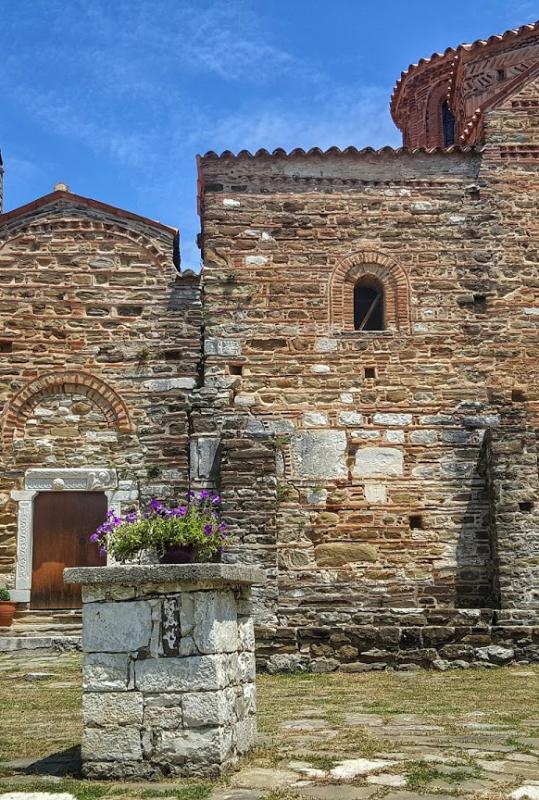
Vlacherna was the catholicon of a male monastery. It was built in 1224-1230 to replace an older church (from the early 10th century), whose remains were incorporated in the new building. If you observe the south wall and the south apsis (the left of the three on the church’s east side) you will notice the different building style of the older church (the stones are irregular and kept together with ample mortar). Vlacherna is a three-aisled basilica with one dome above each aisle (only the main one belongs to the original plan, the others were added at a later date). Soon after its completion, the monastery became all female, but remained an informal haven for deposed emperors in trouble.
4. Church of Panagia Vlacherna
Panagia Vlacherna is an impressive Byzantine church and mausoleum of the Komnenos-Doukas family, whose members ruled the Despotate of Epirus.
Stories

Panic room
The litany
As you enter the church, take a minute and look to your left, to the fresco on the south wall of the narthex. It depicts the litany of the image of the Virgin Hodegetria (“She who shows the Way”), an event that took place every Tuesday in Constantinople. A man is shown holding the icon on his shoulder, surrounded by groups of men and women. An impressive building with columns is visible at the back, with women observing the litany from the balconies. At the foot of the fresco is a lively depiction of various scenes from the marketplace: a man is selling caviar, a woman is selling cabbages, another one has a string of small containers hanging from her neck while two men enjoy a beverage.
East vs West
Why should this litany be depicted on the walls of a church in Arta? Three women that stand out among the crowds may provide the answer. They are Anna Palaiologina, wife of Nikephoros I, ruler of the Despotate of Epirus, her sister Theodora Raoulaina, and her mother Irene-Eulogia, sister of the emperor Michael VIII Palaiologos. The three women were vocal opponents of the emperor’s efforts to restore the unity of the Greek Orthodox and Roman Catholic Church. They fell into disfavour with the emperor but their status was restored when Michael passed away. The fresco seems like a praise and an expression of gratitude towards Anna Palaiologina and her family for their leading role in this crucial ecclesiastical matter.
The mysterious tombs
There are two tombs on the north and south wall of the church, even though their current appearance is due to a 1936 restoration. Vlacherna was a mausoleum for the members of the Komnenos and Doukas families, so it is possible that the south tomb belongs to the ruler Michael II Komnenos Doukas, or his son Nikephoros I. The north tomb, according to a reading of the marble slabs that once covered it (which only partially survives) is the final resting place of Ioannis and Michael, the sons of Michael II and Theodora Petraleifa. The two young men met a violent end (possibly murdered) soon after their father’s death.
Nea Odos
Powered by Clio Muse Tours
Powered by Clio Muse Tours